Project institution: University of Glasgow
Project supervisor(s): Dr Archer Gong Zhang (University of Glasgow) Dr Faiza Samreen (UK Centre for Ecology & Hydrology), Dr Andrew Elliott (University of Glasgow), Prof Marian Scott (University of Glasgow), Dr Heather Price (University of Stirling)
Research area: Atmosphere, Hydrosphere, Cryosphere, and Ecosystem Processes and Evolution
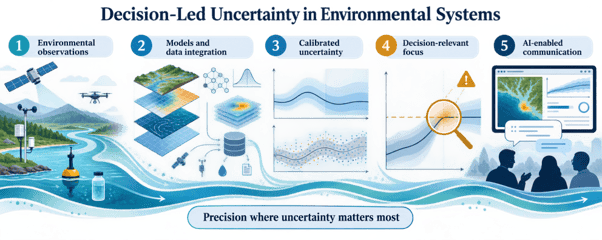
Environmental pollution is one of the biggest challenges of our time, with air, water and soil systems exposed to complex mixtures of contaminants that can affect ecosystems, human health and environmental resilience. Understanding the impacts of the pollutants requires the integration of diverse environmental observations, with advanced AI, statistical, and process-based approaches having significant potential to support informed decision making in a context-driven scenario if the underlying uncertainty arising from environmental variability and the modelling framework is well understood.
However, quantifying this uncertainty is both computationally demanding and difficult to communicate to stakeholders. This work will develop advanced statistical and ML/AI approaches to characterise and communicate uncertainty in environmental models. Crucially, it will explore a decision-led uncertainty paradigm, moving beyond blanket characterisation of uncertainty towards identifying and quantifying the uncertainties that are most relevant to stakeholder priorities/decision making.
Methods Used:
Traditional environmental monitoring and management have focussed on individual potential pollutants or the potential impacts of a small number of pollutants. However, climate change, land-use change and human activities require a systems-based approach to understand the combined effects of multiple pollutants and environmental stressors on ecosystem and human health. Environmental monitoring and prediction involve the use of data from multiple sources (e.g. in situ and satellite) and statistical and machine learning models to support a systems-level understanding of environmental processes, pollutant mixtures and their interactions. Implementing uncertainty quantification for such environmental systems is challenging for two reasons. Firstly, computing accurate measures of uncertainty for such large and complex systems with noisy observational data is computationally extremely demanding, often requiring substantial and well-optimised computational resources. Secondly, even if such uncertainty can be quantified,
communicating uncertainty about future states of environmental systems is difficult, with traditional uncertainty maps often reducing high-dimensional distributions (e.g. multiple quantities over space and time) to low-dimensional or marginal summaries, which could potentially hide the important and critical underlying richness of the uncertainty structure.
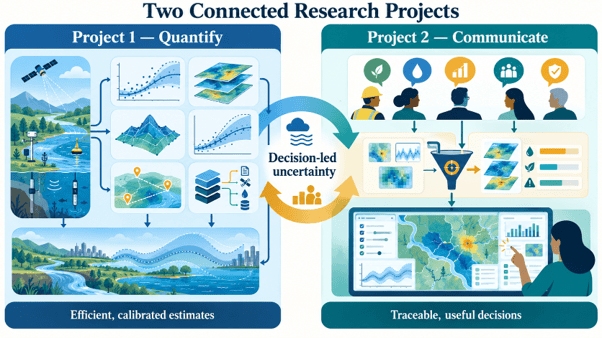
Thus, this project will initially take a dual approach, with further development possible in either or both directions.
Teaser Project 1 Objectives:
Teaser Project 1 will utilise advances in statistical and machine learning methods to improve uncertainty quantification in environmental systems, with a focus on applications in water and air, leveraging the expertise of the supervisory team. To do this, we will explore traditional statistical modelling approaches, including emulation and semiparametric data integration methods such as the density ratio model, alongside ensemble modelling, physics-informed machine learning surrogate models enhanced with conformal prediction (appropriately adjusted for the non-IID observations present in environmental data), and optimised sampling, carefully balancing the computational requirements with the required level of accuracy in uncertainty, with a particular focus on supporting a context-driven and decision-led uncertainty paradigm.
Teaser Project 2 Objectives:
Teaser Project 2 will explore the second problem. We first note that, while exploring all elements of model uncertainty for its own sake may be academically interesting, it may not be computationally efficient or accessible to decision-makers if some aspects of that uncertainty do not influence current decisions or priorities. Instead of asking what the overall uncertainty of the system is, we should focus on the uncertainty most relevant to the impact or decision of interest, for example, deterioration in air/water quality to levels that could affect ecosystem health. The PhD student will engage with end users of environmental datasets, including national government, local authorities, environmental consultancies and charities, to understand how uncertainty is interpreted, communicated and incorporated into decision-making. The project will explore what forms and levels of uncertainty are most relevant and acceptable in different decision contexts, with stakeholder requirements directly informing the development of uncertainty quantification and communication methods.
This gives us two interesting opportunities. First, from a computational perspective, it allows us to focus methodological development in uncertainty quantification on the aspects of the system that are most relevant, while acknowledging our lack of precision in other aspects. Second, by leveraging advances in AI, including LLMs and agentic approaches, this project will explore new ways for stakeholders to interact with, interrogate and understand high-dimensional uncertainty across interconnected environmental processes, pollutant mixtures and stressors. Rather than attempting to communicate the full uncertainty landscape, the research will investigate how AI can help surface the uncertainties most relevant to contextual and current decisions, supporting more effective uncertainty communication and systemic decision making.