PROJECT HIGHLIGHTS
- Quantify what hydrodynamic signals a planktonic organism can detect as a function of sensors, organism size, noise and observation time
- Determine when flow sensing can help an organism such as a copepod find prey, detect predators or respond to obstacles
- Compare flow-informed behaviour with random active motion and develop open-source simulations that can be tested against experimental observations
Overview
Planktonic microorganisms generate over half of the Earth’s oxygen, drive marine carbon cycling, and form the foundation of ocean food webs. Understanding how they detect food, avoid predators and interact with one another is therefore essential for understanding marine ecosystem functioning and responses to environmental change. Yet despite their ecological importance, many aspects of plankton behaviour, particularly at the scale of individual organisms, remain poorly understood.
This project will study one basic source of information: the flow produced by a nearby moving organism. Copepods are a useful model because they can be both predators and prey. They may use flow disturbances to find smaller prey such as ciliates, while detecting and escaping larger predators such as fish. While copepods provide a biological case study, the mathematical framework will be sufficiently general to apply to a broader range of microswimmers and fluid-mediated interactions.
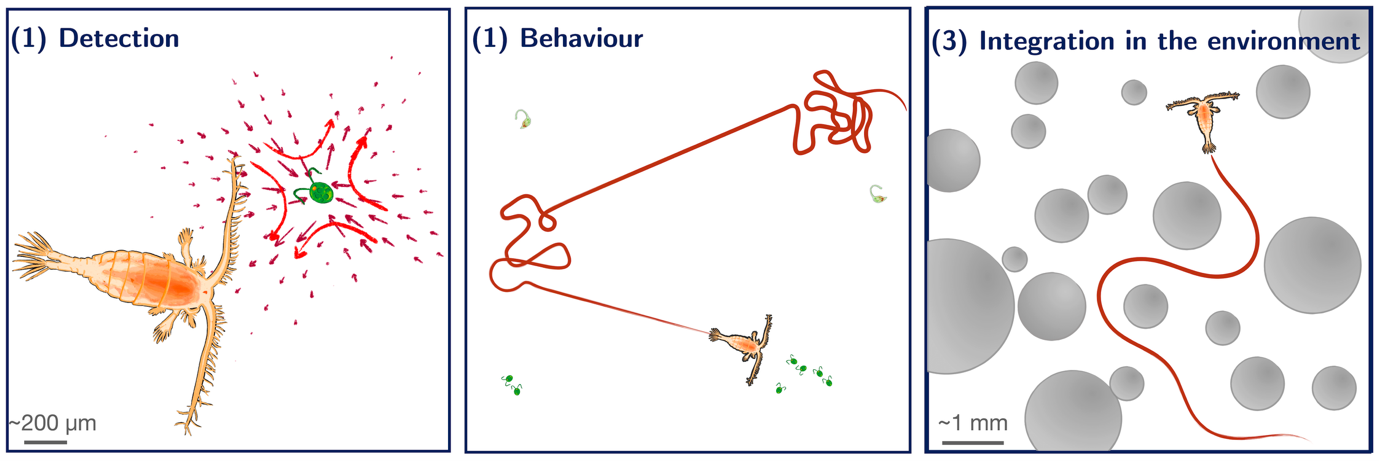
The central question is simple: given an organism’s size and the position and sensitivity of its sensors, what can it detect from the surrounding flow? Physical information is affected by thermal and environmental fluctuations. Sensors are also biologically constrained: measurements are noisy and signals can only be detected above a threshold. We will quantify how sensing accuracy depends on organism size, sensor type and placement, flow characteristics and measurement duration. We will ask when a source can be detected or localised, and how these limits differ between prey sensing, predator sensing and obstacle detection (1).
We will then study the behavioural consequences of this information (2). In simulations, a swimming organism using noisy hydrodynamic measurements will be compared with an active Brownian particle moving without directional information. Performance will be quantified through ecologically relevant measures including prey encounter rates, capture success and predator escape probability. The resulting theory and open-source simulations will generate quantitative predictions that can be compared with experimental observations of plankton interactions (3).
Case Projects
This project does not offer a CASE studentship
Host
- University of Warwick
Theme
- Climate and Environmental Sustainability, Organisms and Ecosystems
Supervisors
Project investigator
- Dr Albane Théry, albane.thery@warwick.ac.uk
Co-investigators
- Professor Tom Montenegro-Johnson, tom.montenegro-johnson@warwick.ac.uk
How to apply
Each host has a slightly different application process.
Find out how to apply for this studentship.
All applications must include the CENTA application form.
Choose your application route
Methodology
The project centres on quantitative models of biological systems, combining microscale fluid mechanics, stochastic modelling and information theory. We will first model the flows generated by moving prey, predators and simple obstacles. Given a specified sensor arrangement, we will incorporate thermal, environmental and measurement noise to quantify an organism’s ability to detect and localise nearby objects over finite observation times. This analysis will identify how sensing performance depends on organism size, sensor placement, sensor sensitivity and memory.
We will then investigate the behavioural consequences of this information by coupling sensing to movement. Dynamical simulations will compare active Brownian motion with organisms that use noisy local flow measurements to guide behaviour. Simple response rules will provide a baseline, while reinforcement learning will identify effective strategies under uncertainty. Applications will focus on copepods interacting with ciliate prey and fish predators. All code and simulation tools will be made openly available.
Training and skills
DRs will be awarded CENTA Training Credits (CTCs) for participation in CENTA-provided and ‘free choice’ external training. One CTC can be earned per 3 hours training, and DRs must accrue 100 CTCs across the three and a half years of their PhD.
This project will be jointly supervised across Warwick Mathematics and the School of Life Sciences, receiving interdisciplinary training in fluid mechanics, stochastic modelling, numerical simulation and mathematical biology. Prof. Montenegro-Johnson will provide complementary expertise in microscale fluid mechanics and computational modelling.
The student will develop skills in reproducible and open-source software, scientific communication and interdisciplinary collaboration, and will participate in relevant Warwick seminars, conferences and summer schools. Existing collaborations in Cambridge and Paris, together with developing links with experimental researchers in Exeter, will provide opportunities to connect mathematical theory with marine biology and emerging experimental observations.
Partners and collaboration
N/a
Possible timeline
Year 1: Literature review and training; develop the fluid mechanic and stochastic sensing model; quantify detection and localisation performance for different source flows; develop the core simulations.
Year 2: Introduce biological and physical constraints, such as sensor physics and geometry; develop open-source simulation tools for detection performance and prepare a first theory-focused publication. Start working on behavioural responses to the flow information.
Year 3: Study of predation / escape strategies with limited flow information. Applications to biological systems, in particular copepod prey-predator interactions; compare predictions with available experimental observations, and experimental collaborations. Prepare publications on behavioural strategies and ecological applications, release software and complete the thesis.
Design follow-up studies, possibly interactions with obstacles or different plankton interactions such as communication.
Further reading
BBC News (2025) Tiny creatures gorge, get fat, and help fight global warming. Available at: http://www.bbc.co.uk/news/uk‐28632223 (Accessed: 10 September 2026).
Eloy, C. (2024) ‘Hydrodynamics of flow sensing in plankton’, The European Physical Journal Special Topics, 233, pp. 2733–2741. doi:10.1140/epjs/s11734-024-01252-w.
Kiørboe, T., Jiang, H., Gonçalves, R. J., Nielsen, L. T. and Wadhwa, N. (2014) ‘Flow disturbances generated by feeding and swimming zooplankton’, Proceedings of the National Academy of Sciences, 111(32), pp. 11738–11743. doi:10.1073/pnas.1405260111.
Colabrese, S., Gustavsson, K., Celani, A. and Biferale, L. (2017) ‘Flow navigation by smart microswimmers via reinforcement learning’, Physical Review Letters, 118, 158004.
doi:10.1103/PhysRevLett.118.158004.
Bachimanchi, H., Midtvedt, B., Midtvedt, D., Selander, E. and Volpe, G. (2022) ‘Microplankton life histories revealed by holographic microscopy and deep learning’, eLife, 11, e79760. doi:10.7554/eLife.79760.
Casas, J. and Dangles, O. (2010) ‘Physical ecology of fluid flow sensing in arthropods’, Annual Review of Entomology, 55, pp. 505–520. doi:10.1146/annurev-ento-112408-085342.
Further details and How to Apply
For informal enquiries contact Dr Albane Théry (Albane.Thery@warwick.ac.uk).
To apply to this project:
- You must include a CENTA studentship application form, downloadable from: CENTA Studentship Application Form 2027
- You must include a CV with the names of at least two referees (preferably three) who can comment on your academic abilities.
- Please submit your application and complete the host institution application process via: https://warwick.ac.uk/fac/sci/lifesci/study/pgr/studentships/nerccenta/ University of Warwick projects will be added here: https://warwick.ac.uk/fac/sci/lifesci/study/pgr/studentships/nerccenta/studentships/ and application guidance is at the bottom of this page. Complete the online application form – selecting course code P-C1PB (Life Sciences PhD); from here you will be taken through to another screen where you can select your desired project. Please enter “NERC studentship” in the Finance section and add Nikki Glover, phd.lifesciences@warwick.ac.uk as the scholarship contact. Please also complete the CENTA Studentship Application Form 2027 and submit via email to phd.lifesciences@warwick.ac.uk. Please quote CENTA 2027-W2 when completing the application form.
Applications must be submitted by 23:59 GMT on Wednesday 6th January 2027.