The unprecedented European wildfires of 2026 have created a unique and rapidly closing opportunity to understand how fire reshapes the movement and storage of carbon across the land-ocean continuum (LOAC). While the impact of wildfires on atmospheric carbon emissions is relatively well understood, far less is known about the fate of the large quantities of black carbon left behind in burned landscapes. Following fire, rainfall can rapidly mobilise BC and transport it through rivers to estuaries and coastal ecosystems, such as saltmarsh where it may contribute to long-term carbon burial. This presents a growing challenge for blue carbon science and accounting: as wildfire activity increases, an unknown proportion of carbon stored in coastal ecosystems may originate from external wildfire sources rather than local ecosystem production. Consequently, the contribution of wildfire-derived black carbon to coastal carbon storage estimates, and climate mitigation frameworks remains unconstrained.
Here, we propose a novel rapid-response investigation of black carbon export to coastal saltmarshes following the unprecedented 2026 wildfires in southern Europe. By combining measurements collected during the critical weeks immediately after the fires with sediment records spanning the last century, we will quantify the transfer of black carbon across the land-ocean continuum and determine the importance of saltmarsh ecosystems as long-term sinks for wildfire-derived black carbon. This unique and rapidly closing post-fire observation window will provide the first direct assessment of how increasing European wildfire activity influences carbon transport, burial, and storage from land to sea, addressing a major uncertainty in both carbon cycle science and blue carbon accounting.
Wildfires are becoming more frequent and severe across the UK and Europe[1], yet the fate of wildfire-derived black carbon (BC) beyond the burned landscape remains a large uncertainty in the global carbon (C) cycle. While research has focused on atmospheric emissions[2], we lack direct observations of how much BC is exported from burned catchments, transported through the Land-Ocean-Aquatic Continuum (LOAC), and ultimately buried in coastal and blue carbon ecosystems[3]. This knowledge gap limits our ability to constrain global BC budgets and assess the wider consequences of increasing wildfire activity for climate regulation and coastal C storage[4].
This project addresses that challenge through unique and time-critical natural experiments created by the exceptional European wildfire season of 2026. The months immediately following major fires represent a narrow observational window during which autumn and winter rainfall events mobilise freshly produced BC[5].
By combining rapid-response sampling with historical sediment records spanning 100 years, the project will deliver the first direct assessment of how contemporary wildfire-driven BC export compares with longer-term BC burial in adjacent saltmarsh soils. This will generate new understanding of the magnitude, timing, composition, and fate of wildfire-derived particulate BC, while providing critical evidence for evaluating the role of coastal ecosystems as long-term sinks for fire-derived BC.
The project outcomes will provide urgently needed observations to improve local, regional and global C budget assessments[6]. They will address a critical uncertainty in blue carbon science – whether increasing wildfire-derived BC inputs enhance C burial in coastal ecosystems and how such inputs should be represented in blue carbon stock assessments, and climate mitigation frameworks.
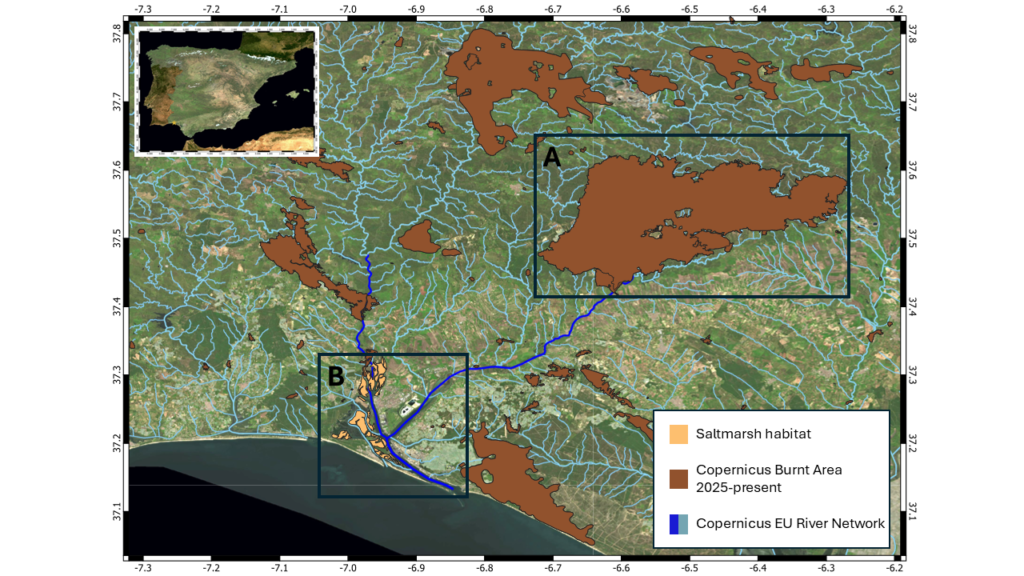
Click on an image to expand
Image Captions
An example Wildfire Area, Spain – Highlighting Blue Carbon Ecosystems
Methodology
The project will exploit the recent increase in wildfire observations, strategically identifying European (and UK) regional windows of opportunity to quantify wildfire derived BC export from burned catchments and determine its contribution to long-term C burial in adjacent blue carbon ecosystems.
This will be achieved through three objectives:
1. Quantify post-fire particulate BC export to coastal ecosystems
Measure the magnitude of BC export from catchments affected by recent wildfires to adjacent saltmarsh environments during the critical months (typically autumn-winter) immediately following fire.
2. Determine the accumulation and burial wildfire-derived particulate BC in saltmarsh soils.
Determine the long-term contribution of wildfire-derived BC to blue carbon storage by quantifying long-term BC burial within century-scale saltmarsh soil archives.
3. Assess the importance of wildfire-derived BC for blue carbon accounting
Integrate contemporary BC export measurements with historical burial records to quantify the contribution of wildfire-derived BC to saltmarsh C storage and evaluate its implications for blue carbon assessments and climate mitigation frameworks.
Project Timeline
Year 1
Assessment of the research state-of-the-art: literature review (month 6)
Undertake training needs assessment (and plan a training programme)
Develop project time-line with supervisors; agree a Gantt Chart of activities, deliverables and milestone
Introduction to Field and Laboratory Methods: Join pilot study location sampling in Spain (with supervisors and Spanish partners)
Undertake training in analytical methods (including St Andrews and SUERC – Ascough is Director of the National Facility)
Fieldwork (season 1)
Year 2
Consolidate literature review and write a policy briefing for the United Nations Ocean Decade Programme on BC in coastal BCEs (Austin leads the programme: https://www.go-bc.co.uk/)
Laboratory programme to analyse and characterize BC in BCEs
First international conference (EGU Vienna, Austria) – contribute presentation of your results to an international audience, build research networks – see a bit of Vienna
Fieldwork (season 2) – responsive mode – monitoring ESA space missions to identify critical field locations for catchment burn
Undertake a programme of laboratory work and training at SUERC
Review career plan with supervisors (assess support needs)
Year 3
Complete fieldwork (e.g. sediment trap collections)
Develop advanced analytical method programme to characterise BC
Work on data analysis and papers
Opportunity to visit international partner organization (secondment)
Year 3.5
Complete thesis work
Build research networks with strategic visits/talks/conferences
Complete publications to submission stage
Focus on career next steps
Training
& Skills
Training will be provided in wildfire analysis, including use of European Space Agency products.
Training will be provided in field sampling methods (wildfire catchments and coastal wetlands, including soil and other environmental monitoring techniques)
Training will be provided in laboratory methods, including BC analyses and advanced analytical thethods at SUERC.
Training will be provided in data analysis and report/paper writing; including policy documents.
Skills will be built in the field of environmental science and management, wildfire science, and blue carbon coastal ecosystems, with the potential to link to carbon accounting.
References & further reading
1. Cappelluti et al., 2026, Ecol.Proc
2. Bowman and Cunningham, 2025, Biology
3. Laicher et al., 2026, Mar Freshw.Res
4. Coppola et al., 2022, Nat.Rev.Earth.Environment
5. Busby and Wilcox, ESPL
6. Friedlingstein et al., 2025, Global Carbon Budget