Project Description
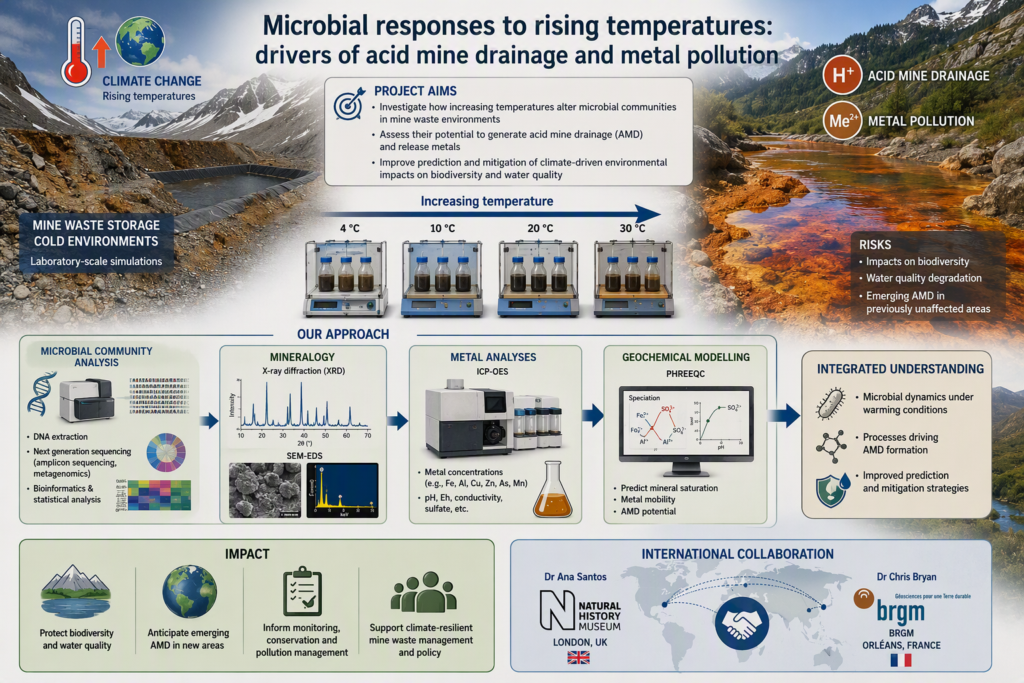
This project aims to investigate microbial responses to rising temperatures associated with climate change. You will be studying how microbial communities change and respond to increasing temperatures and assess their potential to generate acid mine drainage and associated metal pollution. This is particularly relevant given the potential for rising temperatures to alter microbial activity and trigger acid mine drainage generation in areas where it has not previously been observed, posing significant risks to biodiversity and water quality. The advances made through this research will provide a deeper understanding of the microbial dynamics that drive the formation of acid mine drainage under increasing temperatures. This knowledge will improve our ability to predict and mitigate the environmental impacts of climate change on vulnerable ecosystems, while informing future strategies for environmental monitoring, conservation, and pollution management.
You will carry out laboratory-scale experiments simulating mine waste storage in cold environments, determine microbial community responses through next generation sequencing (e.g. amplicon sequencing, metagenomics) and bioinformatics. This will be complemented with mineralogy (e.g. X-ray diffraction, SEM-EDS), metal analyses (e.g. ICP-OES), and modelling (e.g. PHREEQC).
This project is in collaboration with Dr Ana Santos at the Natural History Museum (London, UK) and Dr Chris Bryan at the French Geological Survey (BRGM) in Orléans, France.
Project Specific Training
The student would gain experience in a variety of techniques in microbiology (culturing of acidophiles), molecular biology (e.g. amplicon sequencing, metagenomics, bioinformatics), mineralogy (e.g. XRD, SEM-EDS), chemical analysis (e.g. ICP-OES), and modelling. The supervisors will support the student through one-to-one meetings and hand-on guidance. Additional training will be provided by collaborators at the NHM and BRGM. The supervisory team will support the personal and development plan of the candidate, e.g. attendance to workshops, training programmes, conferences. The student will also benefit from general training offered by the graduate school and university-wide opportunities, social events and facilities.
Potential Career Trajectory
This PhD will provide the student with highly sought-after expertise in environmental microbiology, climate change science, bioinformatics, geochemistry, and environmental modelling. Through training in next-generation sequencing, microbial ecology, mineralogical and geochemical analyses, and predictive modelling, the student will develop a unique interdisciplinary skill set applicable to a wide range of careers. Graduates will be well positioned for roles in academia, environmental consulting, geological surveys, government agencies, conservation organisations, and the mining sector. The international collaborations with the Natural History Museum and BRGM will further enhance networking opportunities and career prospects in environmental research and management worldwide.
In summary, the proposed project will allow the candidate to take this experience and expertise into their future careers whichever sector they go to.
Access and Inclusion Statement
This project is laboratory-based and does not require fieldwork. Any necessary travel (e.g. conference attendance, overseas travel to access BRGM’s facilities) will be arranged so it suits the candidate’s availability. The research will focus on experiments conducted in standard laboratory environments, supported by computational data analysis and regular supervisory meetings.
Reasonable adjustments will be made to ensure equitable access and participation throughout the project. These may include flexible working hours, hybrid participation in meetings and training activities, provision of accessible learning materials, adapted laboratory equipment where feasible, and tailored health and safety arrangements. Laboratory tasks can be planned and scheduled to accommodate individual needs, and alternative approaches to specific activities will be considered where appropriate.
The supervisory team is committed to fostering an inclusive, supportive, and respectful research culture in which all students can contribute and thrive. Applicants are encouraged to discuss any access requirements in confidence so that appropriate support and adjustments can be put in place from the outset of the project and reviewed throughout the studentship as needs evolve.
Project supervisor/s
Carmen Falagan
School of the Environment and Life Sciences
University of Portsmouth
carmen.falagan@port.ac.uk
https://www.port.ac.uk/about-us/structure-and-governance/our-people/our-staff/c…
Ana Santos
Research
Natural History Museum
a.santos@nhm.ac.uk