- Year: 2027
- Primary Supervisor: Lee Brown <l.brown@leeds.ac.uk>
- Institution: University of Leeds (School of Geography)
- Possibility of becoming a CASE project: Yes
- Collaborative Project: No
- Academic Supervisors: Cat Moody <c.s.moody@leeds.ac.uk> (University of Leeds, School of Geography)
- Research Themes: Applied ecology, ecosystem services and conservation, Aquatic/terrestrial/soil biogeochemistry, Climate Impacts, Ecosystem processes, dynamics and functioning, Population, community and behavioural ecology
- Project Partners: Dr Taylor Maavara, Cary Institute of Ecosystem Studies
- Research Keywords: Algae, Bacteria, Biodiversity, Biogeochemistry, Carbon, Carbon Cycle, Carbon Dioxide, Chemistry, Climate Change, Ecology, Ecosystems, Environmental Management, Fieldwork, GC-MS, Lake, Methane, Microbial Ecology, Water, Water Management, Water Resources
- Relevant Degree Courses: Biology, Chemistry, Ecology, Environmental Management, Environmental Science, Geochemistry, Geography, Physical Geography, Water Management
Background
Inland waters such as drinking water reservoirs are hotspots of organic matter processing and turnover, leading to GHG emissions (e.g. CO2, CH4, N2O). Emissions occur from lake surfaces due to processes of gas diffusion and ebullition, as well as from water movements through turbines/valves into downstream river systems. Emissions are known to vary due to a range of variables such as lake surface area, age, weather & climate, and trophic status (e.g. Bastviken & Johnson, 2025; Yang et al., 2026) but datasets are typically collected from short-duration sampling efforts and tend to show high spatial biases at scales including global distribution, national-scale inventories, and even sampling locations on individual lakes. This high level of uncertainty persists despite countries being obliged to estimate and report emissions from reservoirs and flooded land surfaces since a 2019 refinement of the IPCC greenhouse gas inventories (IPCC, 2019).
To overcome data availability limitations, machine learning and remote sensing methods (e.g. Seth et al 2026) are increasingly being developed to identify geographic hotspots and their drivers, and to determine the dynamics of emissions over daily-seasonal-annual scales. However, direct measurements are still considered to be the ‘gold-standard’ when data are needed to quantify reservoir emissions to ground-truth these models. Datasets being used to develop models are often absent from many regions requiring extrapolation to understudies areas, which also means satellite-based estimates lack widespread ground-truthing. However, a major issue with sampling large lakes and reservoirs is ensuring safe access. Sampling typically requires a motorised boat with at least two people on board, which takes significant personnel time and requires boat handling skills, each of which adds significant cost to project budgets. As a result, many current datasets of reservoir gas concentrations are based on sampling restricted to ‘shoreline’ locations.
A key control on aquatic greenhouse gas emissions is water temperature (Yvon-Durocher et al., 2017). As a consequence, ongoing climate change is expected to lead to significant increases in the magnitude of global freshwater GHG emissions (Bastviken & Johnson, 2025). Recent studies have highlighted the contribution of microbes to GHG emissions in inland waters including reservoirs, where microbial communities process aquatic organic matter into CO2, CH4 and N2O (Ghiazza et al., 2026, Wang et al., 2025). Furthermore, the global boom in dam construction continues apace (Zhang & Gu, 2023), driven in part by a need for cleaner electricity from hydropower reservoirs. Many of these new dams are being built in tropical and sub-tropical regions (Chong et al., 2021) where knowledge of GHG emissions is relatively scarce. The combined effects of climate warming, reservoir expansion and emerging evidence for microbial regulation of GHG production highlight the need for better understanding of reservoir carbon dynamics, while the limitations of existing sampling methods call for novel, innovative solutions to address these challenges.
Aim/Methods
This project will use new methods to collect, analyse and interpret greenhouse gas emissions in relation to physical, chemical and biological drivers in understudied reservoir systems. The project offers opportunities to work in areas such as the UK where large numbers of drinking water reservoirs (some almost 200 years old) are located in upland areas around Leeds. Additionally, the studentship could aim to improve understanding of tropical and sub-tropical hydroelectricity reservoirs, utilising linkages with collaborators in countries such as Nepal via ongoing projects at Leeds (e.g. water.leeds.ac.uk/hi-rise). The Leeds team has recently developed a bespoke remote-controlled sampling boat which allows us to collect surface water and gas samples from previously un-sampled areas of reservoirs (see images below). The student will be trained to use this vessel to develop enhanced spatial datasets and push forward general understanding of aquatic GHG emissions and carbon turnover by collecting more accurate data in reservoirs. The student will also have opportunities to develop the boat system electronics further, to carry portable sensors including floating chambers that contain CH4 and CO2 sensors, or to add additional sampling capabilities such as winches for depth specific samples.
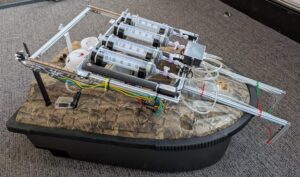
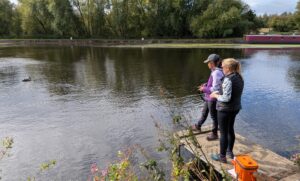
As part of the River Basin Processes & Management group in the School of Geography, and the wider water@leeds network, you will be trained to collect and analyse a range of samples to provide an integrated, ecosystem level approach to better understand reservoir dynamics. Various option include:
- Water chemistry (dissolved C, N & P, metals, pollutants)
- Dissolved gases (CO2, CH4 and N2O, alongside temperature, pressure, humidity and wind speed to determine potential emissions from water surfaces)
- Characterising molecular level dissolved organic matter (forms of carbon in reservoirs provide information on potential Disinfection By Products for water companies)
- Collect water, and extract eDNA to characterise the bacteria and/or fungi population (metabolism, decomposition, processing C, producing CH4 and N2O)
- Measure direct CO2 and CH4 emissions using a floating GHG logger
- Quantify catchment characteristics using GIS analyses, to relate in-reservoir processes to catchment land uses
Outputs/Impact
You will received training in data analysis including statistics and modelling which will allow you to generate publications that improve scientific understanding of spatial and temporal GHG emissions from reservoirs, and their physical, chemical and biological controls. This work will allow you to assess the accuracy of modelled datasets such as G-RES (www.grestool.org/) and earth observation approaches such as Open Hydro (openhydro.net/). Opportunities are expected to arise working with reservoir operators to develop/inform new management strategies. We expect that the new results will be of interests to groups that are compiling national and global models of GHG emissions from surface waters, and for use in water companies carbon accounting. There will be opportunities to connect with these groups via workshops and conference presentations.
References
Bastviken, D., Johnson, M.S. 2025. Future methane emissions from lakes and reservoirs. Nature Water 3, 1397–1410.
Chong, Xin Yi, et al. 2021. A review of the impacts of dams on the hydromorphology of tropical rivers. Science of the Total Environment 794: 148686.
Ghiazza C, Pereira-Mora L, Ferrando L, Chalar G and Fernández-Scavino A (2026) Methane-cycling microbial communities are spatially structured, seasonally dynamic, and functionally coupled in sediments of two nearby eutrophic hydroelectric reservoirs. Frontiers in Microbiology 17:1824828.
IPCC (2019). 2019 Refinement to the 2006 IPCC Guidelines for National Greenhouse Gas Inventories. Volume 4 (AFOLU), Chapter 7: Wetlands. IPCC, Switzerland
Seth et al. 2026. A review of hydropower reservoir GHG estimation methods. Renewable and Sustainable Energy Reviews 233: 116859.
Wang et al. 2025. Untangling the impacts of bacterial community on carbon dioxide and nitrous oxide across a drinking water reservoir. Environmental Research 269, 120892,
Yang, Y., Zhang, H., Herbold, C.W. et al. 2026. Trophic status strongly regulates nitrous oxide but not methane production in global freshwater lake sediments. Nature Communications 17: 3791
Yvon-Durocher, G., Hulatt, C., Woodward, G. et al. 2017. Long-term warming amplifies shifts in the carbon cycle of experimental ponds. Nature Climate Change 7: 209–213
Zhang, A.T., Gu, V.X. 2023. Global Dam Tracker: A database of more than 35,000 dams with location, catchment, and attribute information. Scientific Data 10: 111 (2023).