PROJECT HIGHLIGHTS
- Collaborate with volunteers to map PFAS contamination in UK waters.
- Develop and test innovative capture methods for highly mobile short and ultra-short chain PFAS, pairing these with electrochemical destruction technologies.
- Work in a friendly and cooperative research group at a world leading institution, with the ability to engage with river conservation experts, industry and government partners.
Overview
Environmental per- and polyfluoroalkyl substance (PFAS) pollution is a huge concern due to their persistence and adverse effects on human health and ecological systems. Several medium and long chain PFAS have been regulated, resulting in a shift towards alternatives, such as short and ultra-short chain compounds including trifluoroacetic acid (TFA), perfluorobutanoic acid (PFBA) and perfluorobutane sulfonic acid (PFBS). However, toxicological evidence suggests that these PFAS also cause environmental and health risks. TFA is of particular concern due to its high environmental mobility and ubiquity, typically being detected at concentrations up to two orders of magnitude higher than longer chain PFAS (Chen et al., 2018; Li et al., 2025).
Whilst research is underway to develop PFAS removal technologies from water, most approaches have focused on legacy and long-chain PFAS. In contrast, short and ultra-short compounds have received little attention. PFAS concentrations in rivers and other contaminated surface waters are typically in the ng/L range, meaning that effective treatment requires a capture and preconcentration step before a destruction process. However, conventional preconcentration methods, such as granular and powdered activated carbon and ion-exchange resins, are often less effective for capturing short- and ultrashort-chain PFAS because of their high hydrophilicity and mobility, resulting in rapid breakthrough (Gagliano et al., 2020; Liddie et al., 2026; Scheurer et al., 2017).
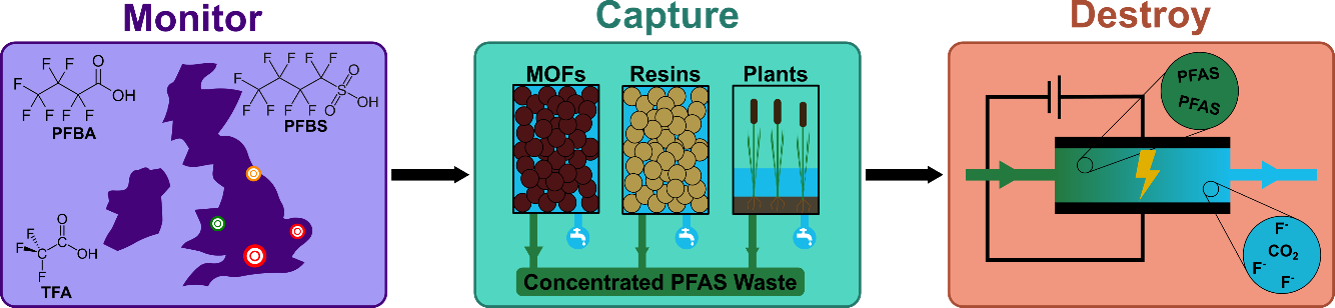
This project aims to develop a PFAS treatment system capable of capturing and preconcentrating short- and ultrashort-chain PFAS from contaminated water sources, followed by their destruction using electrochemical advanced oxidation processes. The focus will be on TFA, PFBA and PFBS. At the first stage of the project, the occurrence and concentrations of these PFAS in UK waters will be mapped through field sampling campaigns and mass spectrometric analysis, with support from Rivers Trust volunteers. Sorbents such as metal-organic frameworks and modified ion-exchange resins, as well as nature-based approaches including phytoremediation (PFAS uptake into plants), will be investigated. Where appropriate, methods for controlled desorption of the PFAS will also be investigated. These concentrated PFAS solutions will be subjected to electrochemical advanced oxidation methods, which offers great potential for complete PFAS destruction through C–F bond cleavage.
Figure 1: Schematic overview of the proposed project, showing: Monitoring: measuring short-chain PFAS in volunteer collected river water samples from around the UK, to identify types and concentrations of short chain PFAS. Capture: Developing testing and deploying capture methods to remove PFAS from natural waters, including metal organic frameworks, resin ion exchange, and plant materials. Destruction: Utilising electrochemical destruction technology to destroy PFAS and contaminated materials.
Methodology
The project requires development of liquid chromatography–mass spectrometry (LC-MS) analytical methods for the detection and quantification of short and ultra-short chain PFAS in environmental samples, and for monitoring their removal during destruction experiments. Fluorine nuclear magnetic resonance (19F NMR) based analytical approaches will also be investigated for quantifying time dependent PFAS removal during destruction experiments. High/ultra-high resolution mass spectrometry will be used for tracking of intermediates during the PFAS destruction process. Suitable methods will be developed for removing adsorbed PFAS from the different adsorbents investigated. PFAS destruction will be carried out using in-house electrochemical advanced oxidation systems which use boron doped diamond electrodes integrated into recirculating flow cells. Monitoring of fluoride ion (F–) release during the electrochemical destruction process will be made using F– ion selective electrodes. Whilst the majority of work will be carried out in the laboratory there will be opportunities for environmental field sampling.
Training and skills
DRs will be awarded CENTA Training Credits (CTCs) for participation in CENTA-provided and ‘free choice’ external training. One CTC can be earned per 3 hours training, and DRs must accrue 100 CTCs across the three and a half years of their PhD.
The student will receive the required analytical training from experts within the research group (in analysis, electrochemistry, LC-MS and NMR) and within the wider department, especially when considering use of multiple MS techniques (Dr. Lijiang Song, Joanna Drozd). Simon Browning (Rivers Trusts) will provide training in the environmental sampling (collection) of water sources. The students will also be trained in how to analyse the data collected with consideration of errors. Training will also be given in 3D printing for electrochemical cell preparation along with skills in presentation, report and paper writing.
Partners and collaboration
The Macpherson group is highly collaborative working with a large range of partners, including industrial and charity/government organisations. The group has three collaborations which are relevant to this proposed work: (1) An ongoing relationship with the Rivers’ Trust to develop low-cost sensors for citizen science, this collaboration would provide the student with training in the collection of freshwater river samples. (2) Work with our local water authority (Severn Trent) investigating electrochemical PFAS destruction technologies related to drinking water. (3) A new collaboration with the Environment Agency, using their data to understand PFAS compounds of greatest concern in water systems.
Year 1: Training in analytical techniques and electrochemical advanced oxidation processes. Development of quantitative method for short/ultrashort chain PFAS detection using MS. Investigation of the short/ultrashort chain PFAS contamination levels across UK water samples.
Year 2: Exploration of current pre-concentration methods to determine efficiency for TFA, PFBA and PFBS. Comparison of current pre-concentration methods with new approaches e.g. phytoremediation, metal organic frameworks, modified ion exchange resins for TFA. Development of appropriate extraction and desorption methods, with a focus first on TFA. Initial exploration of electrochemical destruction.
Year 3: Exploration of PFBA, PFBS, use of real solutions from the field, such as river water systems.
Year 4 (6 months): Completion of outstanding experiments, writing of PhD thesis.
Further reading
Chen, H., Yao, Y., Zhao, Z., Wang, Y., Wang, Q., Ren, C., Wang, B., Sun, H., Alder, A. C., & Kannan, K. (2018). Multimedia distribution and transfer of per- and polyfluoroalkyl substances (PFASs) surrounding two fluorochemical manufacturing facilities in Fuxin, China. Environmental Science & Technology, 52(15), pp. 8263–8271. doi: 10.1021/acs.est.8b00544.
Gagliano, E., Sgroi, M., Falciglia, P. P., Vagliasindi, F. G. A., & Roccaro, P. (2020). Removal of poly- and perfluoroalkyl substances (PFAS) from water by adsorption: Role of PFAS chain length, effect of organic matter and challenges in adsorbent regeneration. Water Research, 171, 115381. doi: 10.1016/j.watres.2019.115381.
Li, J., Boxall, A., Swan, C., Wilkinson, J., McGimpsey, N., Evans, H., Kirton, M., Stanforth, R., Gunby, C., Niemi, L., Taggart, M., Robison-Smith, C., Tarring, E., Bloor, M., & Gauchotte-Lindsay, C. (2025). Concentrations of trifluoroacetic acid (TFA) in UK surface waters. Available at: https://eprints.gla.ac.uk/358007/1/358007.pdf
Liddie, J. M., Kim, E., Haque, F., Roche, A., Sontarp, E. J., & Sunderland, E. M. (2026). Trifluoroacetic acid (TFA) exceeds all other extractable organofluorine in drinking water from Eastern Massachusetts, United States. Environmental Science & Technology Letters, 13(8), pp. 1157–1163. doi: 10.1021/acs.estlett.6c00404.
Scheurer, M., Nödler, K., Freeling, F., Janda, J., Happel, O., Riegel, M., Müller, U., Storck, F. R., Fleig, M., Lange, F. T., Brunsch, A., & Brauch, H.-J. (2017). Small, mobile, persistent: Trifluoroacetate in the water cycle – Overlooked sources, pathways, and consequences for drinking water supply. Water Research, 126, pp. 460–471. doi: 10.1016/j.watres.2017.09.045.
Further details and How to Apply
For more information contact: Prof. Julie Macpherson (j.macpherson@warwick.ac.uk), Dr Joshua Tully (joshua.tully@warwick.ac.uk), Simon Browning (simon.browning@theriverstrust.org) and Dr. Emma Pemberton (emma.pemberton1@environment-agency.gov.uk).
For more information on the Warwick Electrochemistry and Interfaces Group see: www.warwick.ac.uk/fac/sci/chemistry/research/electrochemistry.
To apply to this project:
- You must include a CENTA studentship application form, downloadable from: CENTA Studentship Application Form 2027
- You must include a CV with the names of at least two referees (preferably three) who can comment on your academic abilities.
- Please submit your application and complete the host institution application process via: https://warwick.ac.uk/fac/sci/lifesci/study/pgr/studentships/nerccenta/ University of Warwick projects will be added here: https://warwick.ac.uk/fac/sci/lifesci/study/pgr/studentships/nerccenta/studentships/ and application guidance is at the bottom of this page. Complete the online application form – selecting course code P-C1PB (Life Sciences PhD); from here you will be taken through to another screen where you can select your desired project. Please enter “NERC studentship” in the Finance section and add Nikki Glover, phd.lifesciences@warwick.ac.uk as the scholarship contact. Please also complete the CENTA Studentship Application Form 2027 and submit via email to phd.lifesciences@warwick.ac.uk. Please quote CENTA 2027-W09 when completing the application form.
Applications must be submitted by 23:59 GMT on Wednesday 6th January 2027.