Overview and Background
Technological developments with smart sensors are changing the way that the environment is monitored. Many such smart systems are under development, with small, energy efficient, mobile sensors being trialled. Such systems offer opportunities to change how we monitor the environment, but this requires additional statistical development in the optimisation of the location of the sensors.
The aim of this project is to develop a mathematical and computational inferential framework to identify the best locations to deploy sensors in a complex constrained domain and network, to enable improved detection of water contamination. The proposed method can also be applied to solve regression, classification and optimization problems in a latent manifold which embedded in higher dimensional spaces.
Methodology and Objectives
The idea of on-site sensors to detect water contaminants has a rich history. Since water flows at finite speeds, placing sensors strategically reduces time until detection. The mathematical analysis is often made difficult by the need to model the nonlinear dynamical systems of hydraulics within a non-Euclidean space such as constrained domains (lake or river, Wood et al., 2008) or networks (pipe network, Oluwaseye, et al., 2018). It requires solving large nonlinear systems of differential equations in the complex domain and is difficult to apply to even moderate-sized problems.
This proposed PhD project aims to develop new methods to improve environmental sampling, enabling improved estimation of water pollution and associated uncertainty that appropriately accounts for the geometry and topology of the water body.
Methods Used:
Intrinsic Bayesian Optimization (BO) on complex constrained domains and networks allows the use of the prediction and uncertainty quantification of intrinsic Gaussian processes (GPs) (Niu et al., 2019, 2023) to direct the search of the water pollution. Once new detection is observed, the search for a hotspot can be sequentially updated.
The key ingredients of BO are the Gaussian processes (GPs) prior that captures beliefs about the behaviour of the unknown black-box function in the complex domains. The student will develop intrinsic BO on non-Euclidean spaces such as complex constrained domains and networks with the state-of-the-art GPs on manifolds and GPs on graphs. Extending the idea of estimating covariance functions on manifolds, the project aims to estimate the heat kernel of the point cloud, allowing the incorporation of the intrinsic geometry of the data, and a potentially complex interior structure.
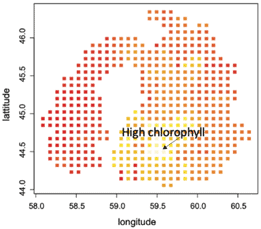
The application areas are water quality in lakes with complex domains (such as the Aral Sea) and pollution sources in a city’s sewage network. The methods would have the potential to inform about emergent water pollution events like algal blooms, providing an early warning system, and help to identify pollution sources.
Teaser Project 1 Objectives: In the first teaser project, the student will apply intrinsic GPs to water quality data, seeking to understand the complex patterns of water quality in non-Euclidean spaces (both continuous domains with complex boundaries and network domains). The student will apply existing methods to small-scale datasets, getting a feel of the methodology used in this area. This work could evolve into a PhD with a focus on developing computationally demanding methods for modelling water quality and detecting hotspots over complex domains. Parallelisation over GPUs would enable modelling across large areas, with high data volumes typical of high spatial resolution water quality data.
Teaser Project 2 Objectives: In the second teaser project, the student will expand their work to the spatio-temporal (or manifold-temporal) setting, incorporating both complex spatial and temporal structures to fully explain the changing nature of the water quality patterns. Again, this teaser project will use involve applying existing methods to small-scale datasets. Due to the high computational complexity of spatio-temporal models, this project has the potential to evolve into a PhD with a focus on developing highly computationally efficient methods, with a focus on parallelisation on GPUs.
The student will benefit from the extensive expertise of the supervisory team. Dr Niu specializes in statistical inference in Non-Euclidean spaces, with application in ecology and environmental science. Dr Wilkie has a background in developing spatiotemporal data fusion approaches for environmental data, focussing on satellite and in-lake water quality data. Prof Chen specializes in network modeling, statistical inference, data science, machine learning and economics. Dr Tso is an environmental data scientist with strong computational background and a portfolio of work on water quality monitoring, including adaptive sampling.
References & Further Reading
- Niu, et al., (2019), “Intrinsic Gaussian processes on complex constrained domain”,J. Roy Statist. Soc. Series B, Volume 81, Issue 3.
- Niu, et al., (2023): Intrinsic Gaussian processes on unknown manifold with probabilistic geometry, Journal of Machine Learning Research; 24 (104).
- Oluwaseye, et al.,(2018) A state-of-the-art review of an optimal sensor placement for contaminant warning system in a water distribution network, Urban Water Journal, 15:10, 985–1000.
- Giudicianni et al., (2020). Topological Placement of Quality Sensors in Water-Distribution Networks without the Recourse to Hydraulic Modeling. Journal of Water Resources Planning and Management, 146(6).
- Wood, S. N., Bravington, M. V. and Hedley, S. L. (2008) Soap film smoothing. J. Royal Stat. Soc. Series B, 70, 931–955